Facts checked Article
Probability notebook
A casino streak looks rarer when you hide the search that found it
Six matching results in a chosen window and six matching results somewhere in a longer record are different events. Count the windows before judging the streak.
The missing part of a streak claim is the search
A streak chosen after looking at a result history does not have the same probability as a particular streak specified before the history exists. The difference is the number of opportunities to find it. Neither calculation makes an independent next result due.
This matters when an online-casino result strip, shared clip or chat message turns a surprising sequence into a forecast.
Suppose someone points to three consecutive A results. Did they predict A on trials one, two and three? Or did they inspect six results and select whichever three-result window looked striking?
Those instructions describe different events. Writing down only the selected window throws away the search that produced it.
We will count both events in a deliberately small model. A and B are labels, not roulette colours, wins or losses. Each trial independently produces either label with probability one half.
There are no stakes, payouts or game features. The calculation is an original teaching experiment, not a test of a casino, and offers no method for choosing bets.
Sources: RTS 7 – Generation of random outcomes.
Chalk box: inputs, assumptions, output
- Inputs
- Six binary trials. A and B are labels, not roulette colours, wins or losses. Each trial independently produces either label with probability one half.Binomial Distribution · as checked on
- Assumptions
- Independent, equally likely trials. There are no stakes, payouts or game features. The calculation is an original teaching experiment, not a test of a casino.Binomial Distribution · as checked on
- Output: streak specified first
- The first three trials must all be A. There are 8 ways to complete the sequence out of 64, so the probability is 12.5%.Binomial Distribution · as checked on
- Output: streak selected afterwards
- AAA appears anywhere among the six results in 20 of the 64 sequences, giving 31.25%. The highlighted pattern is still just AAA.Binomial Distribution · as checked on
- Output: the next trial
- Conditional on having found AAA somewhere in the first six, the next-result probability is still 20/40 = one half for each label.Binomial Distribution · as checked on
The sum on the board before any casino streak claim is read against it. Two questions, two fractions, and a next trial that does not move.
Write down all 64 possibilities
Six binary trials produce 2 × 2 × 2 × 2 × 2 × 2 = 64 ordered sequences. Under our equal-probability and independence assumptions each sequence has probability 1/64. AAAAAA and ABABAB each occupy one place in that list.
One looks more patterned to a person; that does not change the probability of that particular sequence.
First specify the event before examining any result: the first three trials must all be A. The remaining three may be anything. There are 2 × 2 × 2 = 8 ways to complete the sequence, so the probability is 8/64, or 12.5%.
We have counted completions, not simulated a large sample and rounded its observed frequency.
NIST's binomial reference concerns counts of successes across fixed-probability trials. A streak requires more information: the order. Exactly three A results can be arranged together or separated.
Keeping the ordered sequence is essential here; replacing it with the total number of A results would discard the feature we are trying to measure.
Sources: Binomial Distribution.
Now allow the window to move
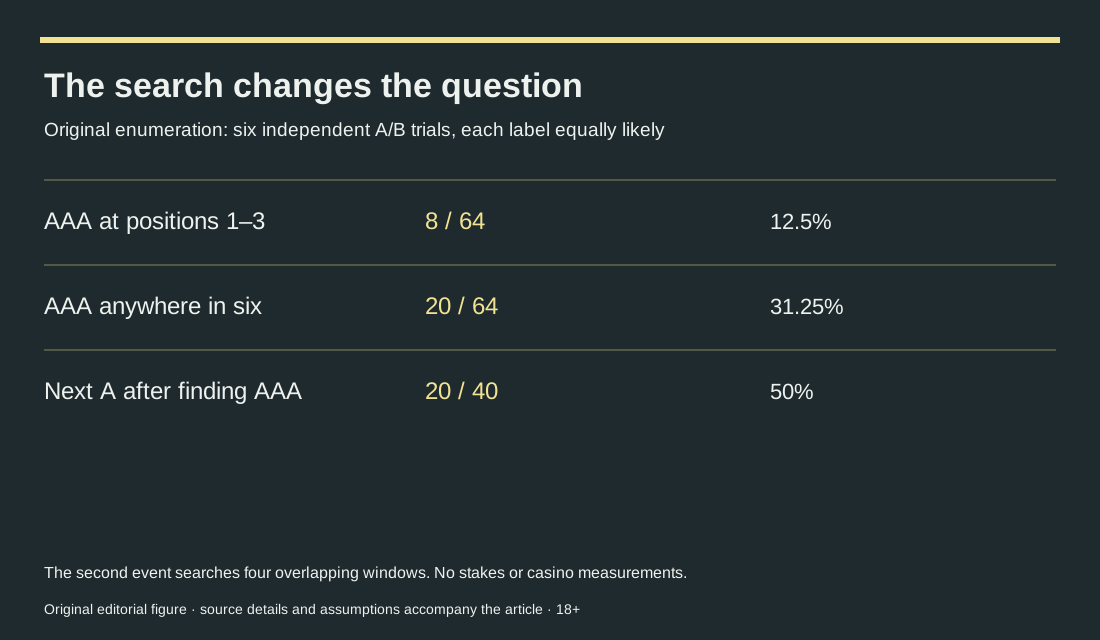
The second event is that AAA appears anywhere among the six results. It can start at position one, two, three or four. Direct enumeration finds 20 sequences containing it, giving 20/64 = 31.25%.
This is two and a half times the first event's probability, even though the highlighted pattern is still just AAA.
To reproduce the count without software, group sequences by the first position at which AAA begins. There are eight beginning AAA: the final three positions are unrestricted. There are four whose first AAA begins at position two: the opening must be BAAA, followed by any two results.
There are four beginning at position three for the first time: position two must be B, position one is unrestricted, and the last position is unrestricted. Finally, four first begin at position four: position three must be B and the first two positions are unrestricted. Eight plus four plus four plus four is 20.
The condition about the first occurrence prevents double counting. AAAAAA contains four matching windows but is one complete sequence. We are counting histories containing a pattern, not counting how many matching windows the histories contain.
| Specified event | Count | Probability |
|---|---|---|
| AAA at positions 1–3 | 8 / 64 | 12.5% |
| AAA anywhere in six | 20 / 64 | 31.25% |
| Next A after finding AAA | 20 / 40 | 50% |
Step by step: reproduce the count of 20 without software
Group the sequences by the first position at which AAA begins. The first-occurrence condition is what stops a history being counted twice.
Step 1: count the histories opening AAA
There are eight beginning AAA. The final three positions are unrestricted.
Step 2: first AAA at position two
There are four whose first AAA begins at position two. The opening must be BAAA, followed by any two results.
Step 3: first AAA at position three
There are four beginning at position three for the first time. Position two must be B, position one is unrestricted, and the last position is unrestricted.
Step 4: first AAA at position four
Four first begin at position four. Position three must be B and the first two positions are unrestricted.
What the result means
Eight plus four plus four plus four is 20, so the probability is 20/64 = 31.25%. AAAAAA contains four matching windows but is one complete sequence: we are counting histories containing a pattern, not matching windows.
Four windows do not mean four independent chances
It is tempting to multiply the single-window probability by four and call the answer 50%. That gives the expected number of matching windows, 0.5, rather than the probability of at least one. Some histories contribute several windows.
Treating those counts as separate histories inflates the result.
Nor can we use 1 − (1 − 1/8)^4 as an exact shortcut. That expression would require independent window events. Adjacent windows share two trials.
In AAAAAA every window qualifies; in AAABBB only the first does. Those shared positions connect the windows even though the underlying individual trials are independent.
This is a useful distinction beyond this example: independent inputs can create overlapping summaries that are dependent. A moving average, rolling count or sliding streak display reuses observations. The word independent needs to attach to the right object.
Here it describes the trials, not the four windows we construct from them.
Our figure therefore presents two questions and two fractions, rather than four separate chance boxes. The denominator stays 64 because the experiment still produces one six-result history.
Knowing the streak does not change trial seven
Extend every six-result sequence by one independent trial. Each has two possible continuations, A and B, producing 128 equally likely seven-result sequences. Of the 20 six-result histories containing AAA, 20 continuations finish with A and 20 finish with B.
Conditional on having found AAA somewhere in the first six, the next-result probability is still 20/40 = one half for each label.
That is a concrete reason the streak supplies no next-result advantage in this model. It does not depend on calling the history uninteresting. The history can be interesting to describe while carrying no information about an independent future label.
The same conclusion holds if the first three results were specified and then all came up A. The probability of observing that initial event was 12.5%. Once it has happened, it is part of the known record.
Multiplying its old probability into the next-result calculation answers a question about the whole sequence before it began, not the conditional question asked now.
Nothing in this reasoning says real financial outcomes are evenly balanced. We deliberately left money out. Equal probabilities for two labels do not establish a fair payout schedule.
Change the search and the denominator must follow
A screenshot may have been selected from many sessions, many players or several different patterns. Allowing either AAA or BBB expands the event again. Searching for alternating results as well as repeated ones changes it further.
Our 31.25% figure answers none of those broader questions: it applies only to AAA somewhere in six independent, equally likely binary trials.
Ask for the rule used to select the example. Was the sequence length fixed? Were unsuccessful searches retained?
Could either label qualify? Were multiple accounts or days examined? These are questions about evidence, not allegations that a screenshot has been altered.
An authentic record can still be presented without enough context to justify its caption.
NIST describes a runs test that examines a defined data sequence rather than treating one eye-catching patch as a verdict. We do not run that test here or attach a significance level to a casino history. The lesson we take is methodological: define the sequence and analysis before interpreting the result.
A statistical test requires its own assumptions and cannot repair an unknown selection process simply by producing a small number.
Sources: Runs Test for Detecting Non-randomness.
Ask for the rule used to select the example
These are questions about evidence, not allegations that a screenshot has been altered. An authentic record can still be presented without enough context to justify its caption.
Ticks are kept only in this browser and are never sent anywhere.
Read the actual game before assuming independence
The Gambling Commission's RTS 7 requires covered random outcomes to meet randomness requirements and prohibits compensated adaptive behaviour. It also recognises properly described features with different rules. That is not a licence to treat every visible event in every game as an identical coin toss.
A bonus feature can change the state of a game. A card drawn from a remaining pack can alter what remains available. A displayed result may combine several underlying events.
Before borrowing our arithmetic, identify what counts as one trial, what the possible outcomes are, and whether previous outcomes change their probabilities under the published rules.
Our example contains none of those mechanisms. It is useful precisely because its assumptions are exposed. If a real product does not fit them, the numerical result cannot be carried over merely because its history also contains repeated symbols.
The relevant game rules would need their own analysis.
Likewise, a short streak neither certifies a random-number generator nor establishes a fault. This article has not inspected source code, laboratory reports or an operator's event logs. It explains how a selection rule changes a probability statement.
Sources: RTS 7 – Generation of random outcomes.
Words used on the board
- RTS
- The Gambling Commission's remote gambling and software technical standards; RTS 7 is the part on generating random outcomes.
- Binomial distribution
- The reference model for counting successes across a fixed number of fixed-probability trials. It keeps the total and discards the order.
- Runs test
- A statistical test, described by NIST, that examines a whole defined sequence for non-randomness rather than one eye-catching patch.
- Independent
- Earlier results do not change the probability of the next trial. Here the word describes the trials, not the overlapping windows built from them.
- Window
- A block of three consecutive positions within the six-result history. Four such windows exist, and neighbouring windows share two trials.
Keep the event and the forecast in separate sentences
A defensible description of our experiment is: among the 64 equally likely six-result histories, 20 contain AAA somewhere. A defensible forecast is: after any such history, our independent seventh trial remains equally likely to be A or B. Both statements can be true together.
For an online-casino streak claim, write the event in one sentence and the proposed prediction in another. Then look for the missing step connecting them. A surprising past event, even when its probability is correctly calculated, does not by itself supply that connection.
The practical use of this exercise is to recognise an incomplete claim before acting on it. It is not a reason to extend a session, search for more streaks or try to recover a loss. The arithmetic describes a record under stated assumptions; it does not turn casino play into an income method.
Two sentences before acting on a casino streak claim
A surprising past event, even when its probability is correctly calculated, does not by itself connect to a forecast.
Ticks are kept only in this browser and are never sent anywhere.
Questions answered
Why does a streak not mean anything?
A streak describes the past. In the independent model used here it does not change the next outcome, although its probability still depends on how the streak was selected.
Why are independent events not due?
Independence means the known earlier results do not change the probability of the next trial. It does not require a short sequence to balance itself.
Is finding three matching results the same as predicting them?
No. AAA in the first three positions occurs in 8 of our 64 histories; AAA anywhere in six positions occurs in 20. The second question permits more opportunities.
Can a runs test show whether a sequence is random?
NIST describes a runs test for investigating non-randomness in a defined sequence. A selected casino streak alone is not that test, and this article reports no operator randomness test.
Does finding AAA in six results change the chance on the seventh trial?
No. Of the 20 six-result histories containing AAA, 20 continuations finish with A and 20 finish with B, so the next-result probability is still 20/40 = one half for each label.
Why can I not multiply the single-window probability by four?
Multiplying by four gives the expected number of matching windows, 0.5, rather than the probability of at least one. Adjacent windows share two trials, so the four window events are not independent.
Can this arithmetic be carried over to a real casino game?
Only if the game fits the assumptions: one clear trial, known outcomes and no change in probabilities from earlier outcomes under the published rules. A bonus feature or a card drawn from a remaining pack can break them.
Methods & sources
Continue reading
One or more is not certainty: the sum, worked in pounds
Over ten independent trials at a fixed 10% chance, the chance of one or more occurrences is 65.13%. Here is the sum, the assumption it rests on, and where it breaks.
Read One or more is not certainty: the sum, worked in pounds
An average is not a session forecast
Expected value describes a mathematical average. It does not describe the money a particular person will finish with.
Read An average is not a session forecast
A longer casino session changes more than the average loss
A fixed-stake experiment separates expected loss, cash swings and the chance of finishing ahead. More trials do not turn any of those into a personal forecast.
Read A longer casino session changes more than the average loss
What is the house edge in blackjack: the sum, worked in pounds
The house edge in blackjack is the operator’s share of each £1 staked over a very large number of hands: about 0.28% under liberal rules with basic strategy, and 1.36 points more when blackjack pays 6 to 5. The working, with £10 put through it.
Read What is the house edge in blackjack: the sum, worked in pounds
What is casino house edge and how does it work?
Casino house edge is the share of each £1 staked that the operator keeps on average. It comes from the gap between true odds and paid odds: £10 on red at a single-zero wheel costs 27p, or 2.70%.
Read What is casino house edge and how does it work?
How do you read online casino probabilities without confusing the question?
Separate the chance of an event, the expected count and the value of a payout, with worked examples and an offline probability worksheet.
Read How do you read online casino probabilities without confusing the question?
Continue reading
One or more is not certainty: the sum, worked in pounds
Over ten independent trials at a fixed 10% chance, the chance of one or more occurrences is 65.13%. Here is the sum, the assumption it rests on, and where it breaks.
Read One or more is not certainty: the sum, worked in poundsWhat is the house edge in blackjack: the sum, worked in pounds
The house edge in blackjack is the operator’s share of each £1 staked over a very large number of hands: about 0.28% under liberal rules with basic strategy, and 1.36 points more when blackjack pays 6 to 5. The working, with £10 put through it.
Read What is the house edge in blackjack: the sum, worked in poundsA longer casino session changes more than the average loss
A fixed-stake experiment separates expected loss, cash swings and the chance of finishing ahead. More trials do not turn any of those into a personal forecast.
Read A longer casino session changes more than the average lossAt least one: the probability lab
One or more is not certainty: the sum, worked in pounds
An average is not a session forecast
What is casino house edge and how does it work?
How do you read online casino probabilities without confusing the question?
A longer casino session changes more than the average loss
What is the house edge in blackjack: the sum, worked in pounds