Probability field guide
How do you read online casino probabilities without confusing the question?
Separate the chance of an event, the expected count and the value of a payout, with worked examples and an offline probability worksheet.
Write the question in a complete sentence
“What are the odds?” is often too short to calculate. It could mean the chance of a particular symbol arrangement on the next play, the chance of seeing a feature at least once in a fixed sequence, or the expected money returned across many possible outcomes. Those questions need different inputs and produce different kinds of answers. A number becomes useful only when the reader can say what it measures.
For an online casino description, start a note with the event, the unit of observation and the time frame. “A prize greater than the stake on the next play” is more precise than “a win”. “At least one specified event in five trials chosen in advance” is more precise than “it happens regularly”. This guide uses invented models to practise that translation. It does not recover the hidden probabilities of a commercial game or claim that an attractive display supplies them.
Write down what remains unknown before opening a calculator. If the rules disclose an average return but no feature probability, leave the feature probability unknown. Substituting an average because it is the only available percentage would answer a different question with false precision.
Choose a unit: event, count or money
Our first distinction is between three units. A probability is a number from zero to one, often displayed as a percentage. A count is the number of occurrences. A money expectation is a weighted average of monetary outcomes. They can appear in the same calculation while meaning very different things.
Imagine an invented event with a 20% probability on each of five independent trials. The expected number of occurrences is one. That does not say the chance of exactly one occurrence is 100%, nor that the event must occur before the fifth trial. A sequence could contain none, one or several. The expected count describes the average across the whole collection of possible sequences.
Attach the unit every time you copy a result. “One expected occurrence” is legible; “the answer is one” invites confusion. The NIST binomial reference supplies the standard count model and its mean. Our examples below make its assumptions explicit and use deliberately invented inputs rather than presenting a real casino frequency.
Sources: NIST: binomial distribution.
A probability tree with room for every result
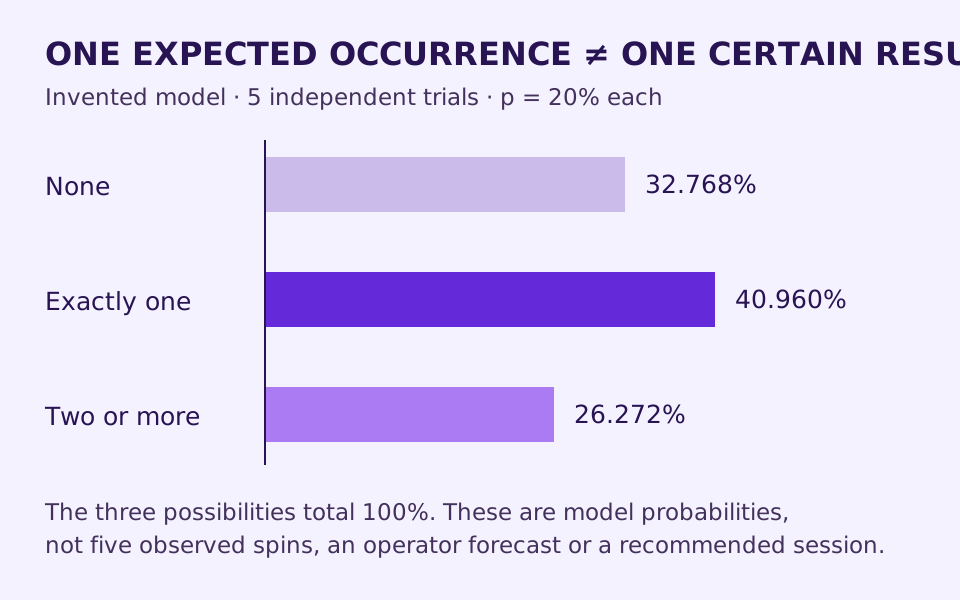
For that five-trial model, the chance of no occurrence is 0.8 multiplied by itself five times, or 0.32768. As a percentage, that is 32.768%. Exactly one occurrence can happen in five different positions. Each position has probability 0.2 × 0.8⁴, so the total is 5 × 0.2 × 0.8⁴ = 40.96%.
The remaining possibility is two or more. Subtract the first two categories from one: 1 − 0.32768 − 0.4096 = 0.26272, or 26.272%. These categories do not overlap and cover every possible count, so their percentages add to 100%. The diagram shows this partition. It does not show the results of an experiment that was actually run.
This gives a useful error check. If the categories overlap, adding them may exceed 100%. If they leave an outcome out, the total may be below it. Before worrying about decimal places, check the way the question divides the possibilities. The existing explanation of at least one develops the complementary event in more detail.
Sources: NIST: binomial distribution.
Exactly, at least and at most are different boundaries
Small words determine which outcomes belong in the answer. Exactly one includes only the count one. At least one includes one, two and every higher count available in the model. At most one includes zero and one. With our example, those three answers are 40.96%, 67.232% and 73.728% respectively.
NIST distinguishes the probability at a particular discrete value from a cumulative probability at or below a boundary. That distinction is the reason a calculator must know which question was intended. A headline about a feature occurring within a sequence is not interchangeable with a claim about its next-play probability.
Try reading the words aloud before entering values. Then list the smallest and largest counts that satisfy the question. If at most one starts at one in your notes, zero has gone missing. If exactly one includes two because the event happened once before happening again, the word exactly has been lost. This simple boundary check catches mistakes that a technically correct formula cannot repair.
Sources: NIST: related distribution functions.
Put the stake beside a payout expectation
Now change the question from an event count to money. Suppose a completely specified teaching game costs £2 per trial. It returns a gross prize of £7 with probability one quarter and £0 otherwise. Its expected gross prize is 0.25 × £7 + 0.75 × £0 = £1.75. Subtracting the £2 stake gives an expected net result of minus 25p per trial.
The £7 outcome produces £5 net profit because the cost has already been paid. The £0 outcome produces a £2 net loss. Weighting those net outcomes gives the same answer: 0.25 × £5 + 0.75 × (−£2) = −£0.25. Agreement between the two methods is a useful accounting check.
Neither possible trial returns £1.75. That figure is an expectation, not a missing third prize. Our separate expected-value note explains why an average need not resemble a particular result. This model has no bonus terms, changing stake or account balance process; importing those conditions would require additional definitions before the same arithmetic could describe them.
The expected gross prize divided by the stake is 87.5%, yet the probability of a positive gross prize is only 25%. Those percentages coexist because they measure different things. The first compares expected money with money staked; the second counts which possible trials pay a prize. Treating 87.5% as the chance of a win would replace a monetary ratio with an event probability. Writing the numerator and denominator in words exposes the substitution immediately.
Check independence without turning it into a slogan
The five-trial calculation assumes that learning the result of one trial does not change the probabilities assigned to the next. It also assumes that the probability stays at 20%. If either condition changes, the calculation must change. The appearance of a familiar game or a random-looking sequence does not prove those assumptions.
For covered remote games, the Gambling Commission’s RTS7 requires acceptably random outcomes and prohibits compensated adaptive behaviour. That is a regulatory requirement with a stated scope. It is not evidence from our own inspection that a named product complies, and it does not give this guide every commercial game’s probability table.
A rules-defined feature may introduce a different state. A finite collection sampled without replacement also differs from tickets replaced after each draw. The relevant task is to identify how the mechanism is described, not to stretch one formula over every situation. A short run of outcomes is especially weak evidence for deciding whether a complicated system follows its specification.
Sources: Gambling Commission: random outcomes.
Do not let a selected screenshot redefine the experiment
An example chosen after the results are known answers a different question from a sequence specified beforehand. Selecting the most dramatic five-result window from a long display is not the same as asking what the next five trials will contain. The selection rule has become part of the observation, even if it is absent from the caption.
When documenting a screenshot, record what was selected and why. Was the sequence the first five trials, the last five visible results, or the most striking run found during a search? Was an event defined before looking, or only after noticing a pattern? These questions do not establish wrongdoing. They identify what kind of conclusion the example can support.
Keep an illustration separate from a dataset. One image can explain a screen layout, but it usually cannot support a reliable estimate of an unknown probability. Counts need a defined sampling method and denominator. A neat crop that removes that context makes the apparent precision of the remaining numbers less useful.
Use the worksheet to compare questions, not playing plans
The offline worksheet offers four outputs: no occurrence, exactly one, two or more, and expected count. Change the question while keeping the probability and number of trials fixed. Notice when the output changes from a percentage to a count. That unit change is the central lesson; a larger number is not automatically a better result.
Try the boundary cases too. At a probability of zero, every fixed trial fails to produce the event. At 100%, every trial produces it. For one trial, two or more occurrences is impossible under this binary model. Boundary cases make it easier to notice a missing zero, an incorrect exponent or a calculator that labels every output as a probability.
The tool does not suggest stakes, length of play or ways to recover losses. It sends nothing to a casino, reads no account and saves no inputs. Its results belong to the assumptions you entered. A useful finished note states the question, the model, the answer with its unit, and the limits that prevent it becoming a prediction about a real session.
Compare zero, exactly one, two-or-more and expected-count outputs under a fixed independent-trial model.
Questions answered
Does an expected count of one mean an event must happen once?
No. In the example of five independent trials with a 20% chance each, the expected count is one but the chance of exactly one occurrence is 40.96%. Other counts remain possible.
Can I calculate a feature probability from a slot’s RTP?
RTP alone does not disclose the complete outcome distribution or a particular feature probability. The needed input may remain unknown unless the relevant game documentation supplies it.
Does a losing run change an independent trial’s chance?
Under the stated independent, fixed-probability model it does not. That mathematical assumption must not be inferred merely from a results display or applied to a different changing-state model.